The warm-up is one of the most important preparatory phases of any workout, regardless of the type of sport or performance we do. There are at least three reasons that make this phase particularly delicate and strategic:
It helps avoid excessive fatigue in the early stages of the practice or routine we are about to perform, supporting a training phase that is balanced in terms of effort as well
It prevents muscle injuries such as strains, tears and contractures
It also prevents tendon and ligament injuries
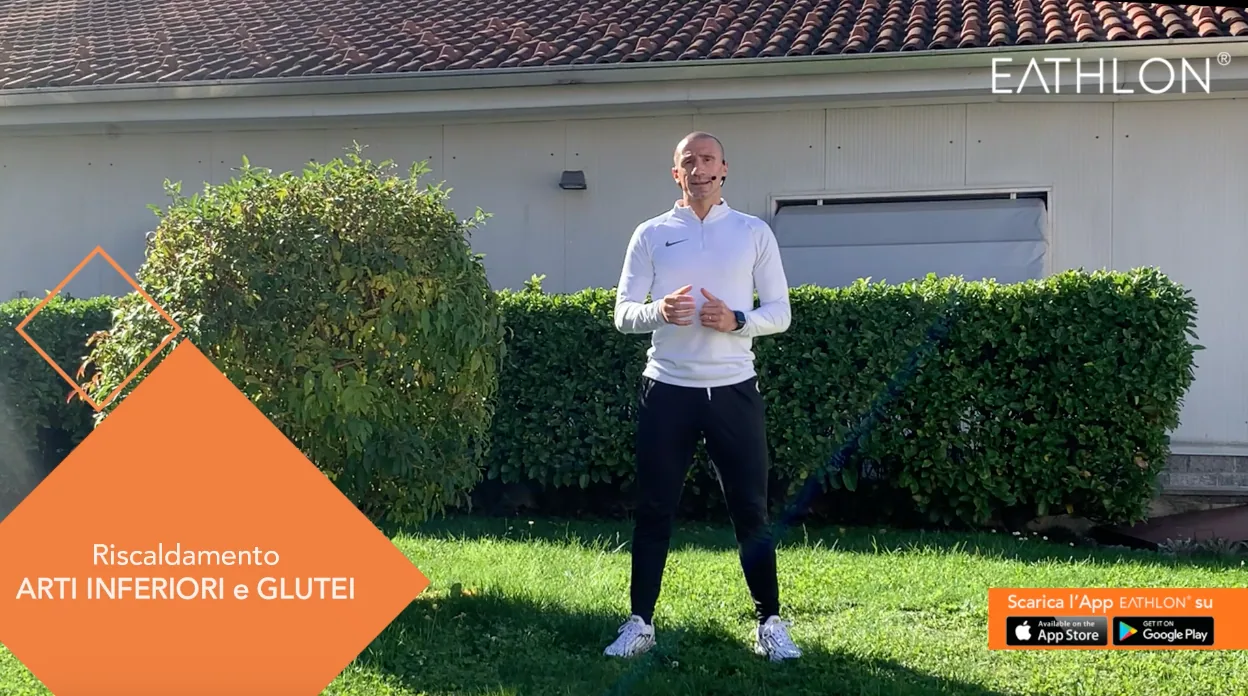
That is why we are splitting this phase into two tutorials, showing below how to perform the exercises for the lower limbs and glutes, and leaving those focused on the upper body for the next piece of content.
Four simple, useful exercises, in two groups
The first pair of exercises: high knees and leg curl
Both work on knee flexion and extension, allowing a targeted warm-up of the quadriceps and biceps femoris.
1) High Knees
Lift your knee above the line of your pelvis
Remember that it rises toward the same shoulder
Alternate one knee and then the other
Your toes point down, extended
As always when doing localized exercises, remember to keep correct posture in the other parts of your body, keeping your abs and core well under control.
2) Leg Curl
Bring your right heel and your left heel to your glutes, alternating sides
With each rep, try to get a little closer each time
While performing this exercise you will feel your hamstrings working the most. As always, try to move in a controlled way, without forcing the movement in ways that alter your posture. Avoid swinging that relies too much on momentum to perform the movement, which reduces muscle tension.
Download Eathlon®, the first 7 days are free
The second pair of exercises: hip extension and side swings
These two exercises focus more on warming up the glutes.
3) Hip extension
Keep the leg that starts the movement straight
The limb tries to go past the trunk in extension
Alternate legs
Try to activate the whole posterior chain of the leg
The hip extension movement, if performed with control and attention, mainly involves the gluteus maximus.
4) Side swings
Swing out to the side, alternating your right and left leg
Activate the outer thigh area as well as the gluteus minimus and medius
Here too, remember to control your movements: always keep your torso still, your back straight and your shoulders motionless, both as you open and as you close, without swaying sideways. Return to the starting position, controlling the movement of the leg.Mindful physical activity, even in preparatory phases such as the warm-up, which we will keep exploring in more depth, should be paired with a balanced, varied diet based on the Mediterranean Diet. Eathlon®, the app of your digital nutritionist, provides a personalized meal plan that supports your sport and is based on your lifestyle. For example, a valuable ally is blueberries. Blueberries contain numerous active compounds, including anthocyanosides, vitamins A and C, citric and malic acid, neomyrtillin, with a marked antidiabetic and capillary-protective effect, phosphorus, calcium and manganese, as well as substances such as arbutin, tannins and quinic acid. Blueberries are also a valuable help for urinary infections thanks to their organic acids, which naturally disinfect and lower the bacterial load right at the site of the infection. In the case of intestinal infections too, blueberry-based remedies are a valid aid for improving the gastrointestinal situation.The Eathlon® method, the Mediterranean Diet personalized and functional to your sport, suggests the right combination of meals, even for fruits with unexpected properties like these.