Eathlon Scientific Method
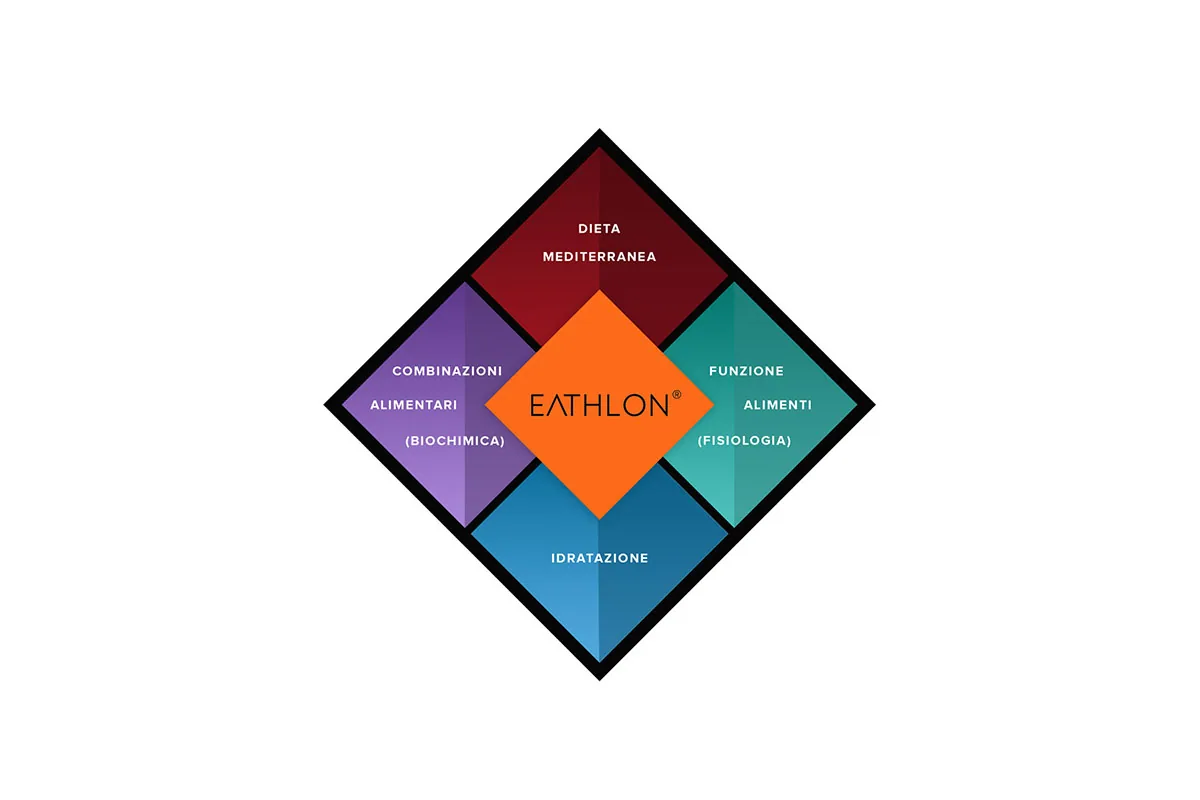
SPORT AND THE MEDITERRANEAN DIET: A WAY OF EATING THAT IS TRADITION, CULTURE, PLEASURE, SOCIALIZING AND BALANCE
The Mediterranean Diet, which UNESCO declared an Intangible Cultural Heritage of Humanity in 2010, is the eating pattern currently used as a reference for people who play sports at an amateur level, and it is the same one adopted by most athletes on every continent. For centuries, the people of the Mediterranean countries have eaten the foods typical of these areas: cereals, legumes, fruit, vegetables, fish, white meat, milk and extra virgin olive oil, enjoying decidedly better health than populations in other parts of the world.
Since the 1980s, the Mediterranean way of eating has replaced the high-protein Anglo-Saxon model and the high-carbohydrate Scandinavian model that were previously used in sport. This regimen essentially provides carbohydrates ranging from 50-60%, protein at 15-20% and fat at 20-30%. Of the carbohydrates, 80-90% should be complex (bread, pasta, rice, etc.) and only 10-20% should come from simple sugars. Protein should be split between animal sources (meat, fish, eggs, etc.) and plant sources (legumes, cereals, nuts, etc.), ranging from 1.0-1.5 and at most 2.0 g/kg of body weight depending on the sport practiced and the goal of the activity.
The fats consumed should be mainly monounsaturated fatty acids, found in extra virgin olive oil.
An excellent supply of minerals, vitamins and fiber is also ensured thanks to the abundant intake of vegetables, all rounded off by adequate hydration.
This eating pattern is well suited to meeting the nutritional needs of athletes, especially during "chronic" preparation, that is, the whole seasonal training period in its different phases. During this time a "prudent" diet should in fact be followed, one that respects the qualitative guidelines above, in line with the Mediterranean pattern, and that provides enough energy to cover expenditure and the structural needs linked to building muscle and repairing worn tissues.
Getting the timing of energy intake right across the day completes the suitability of an athlete's diet. During chronic preparation, for example in muscle-building periods, you can cut back a little on pasta, bread, rice and carbohydrates in general and eat more meat, fish, milk and eggs, that is, animal protein, to support muscle development.
Even in the so-called "acute" phases of preparation, that is, those close to competitions, the Mediterranean diet offers many ways to adjust and personalize according to individual needs.Before a race, especially a long one, protein can be reduced while carbohydrates should be increased, so you can eat less meat and more pasta or rice dishes with light dressings, nuts and dried fruit, to provide all the energy needed for the competition.
Many nutrients in the Mediterranean diet improve physical performance immediately or within a few days, so it makes sense to think that a complete eating pattern including these nutrients can also improve performance. However, these benefits were also lost quickly when people switched to a different type of diet, which underlines the importance of sticking to the Mediterranean diet in the long term.
In essence, nutrition must be an integral part of an athlete's whole training program and, while it is true that there are no miracle foods for achieving a result, it is also true that poor nutrition can compromise performance and therefore athletic output.
The Mediterranean diet also improves athletic performance in endurance sports. This is what emerges from a new study by members of Saint Louis University, published in the Journal of the American College of Nutrition, whose authors found that participants were able to run 6% faster after eating a Mediterranean diet than after other eating patterns.
FOOD COMBINATIONS
Nutrition is an important factor that affects health and that we can change.
Proper nutrition is fundamental to staying healthy and to ensuring the development of body structures in childhood, and it is just as essential for keeping the body efficient in adults and older people. It can also play an important role in preventing many degenerative diseases, such as obesity, cardiovascular disease, diabetes and cancer.
In recent times there has been a nutritional transition: we have gone from a state of
undernutrition (a lack of micro- and macronutrients) to a state of overnutrition, in terms of both the quantity of calories consumed and the quality of food (that is, the composition of meals).
There has been a substantial change in food intake, and what we currently see is an excess of energy, an excess of fat and/or protein, a drop in nutrient intake and high consumption of alcohol and salt. All of this, combined with too little physical activity, leads to chronic degenerative diseases such as obesity, diabetes, osteoporosis and cancer.
Nutrition is not based only on digesting food, but above all on the availability of what the body needs, on the biochemical properties and functions of the macronutrients, micronutrients and non-nutrients found in food; on the biochemical and functional aspects of the processes that allow us to modify and use food matter, and on the biochemical mechanisms underlying human nutrition. For example, after intense physical activity the body needs both carbohydrates and protein, and taking carbohydrates after the protein has been digested is the best way to slow down the replenishment of glycogen stores.
Stopping at digestion alone is rather reductive because it ignores every other metabolic aspect of food. For example, everyone knows that a few drops of lemon (thanks to its vitamin C) on a steak improve the absorption of the iron contained in the meat.
By studying how the digestive system works, we find that there are favorable food combinations, whose simultaneous digestion causes no problems and even completes the macro- and micronutrient intake of the meal, and other combinations where this is not the case.
Many nutrition books give advice that very often contradicts each other: some call for balance, without taking drastic positions, while others give advice that, if followed to the letter, makes the diet extremely rigid and hard to keep up for a long time.
A healthy person can choose food combinations to ensure the metabolism works properly and for the pleasure of eating.
The rules below should be a reference point for everyday eating. Of course you can break these rules, which should be followed more or less to the letter depending on how your commitments are planned. It is advisable, however, not to break more than one rule per meal.
Before an intense work session, it is best to follow them to the letter, as it is after intense sport or after a stressful day.
Proteins from different sources
Combining different protein foods can cause problems. Our stomach is able to produce gastric juices at different times and with different compositions, depending on the proteins to be digested. For example, the gastric juice for meat is strongly acidic right from the start, whereas the one for milk is acidic only toward the end of digestion, so a particularly harmful combination can be meat or fish with milk, because milk, on contact with stomach acid, curdles into lumps and flakes that may contain fragments of meat which, not coming into contact with the gastric juice, risk passing unchanged into the next stretch of the intestine, giving rise to putrefaction. The only protein that can be combined with the others is the egg!
Sugars and starches, or sugars and proteins
Proteins and starches are digested in the stomach, while simple sugars are digested in the intestine. If eaten together, the sugars stay in the stomach for as long as it takes to process the starches or proteins, causing fermentation that in turn hinders the digestion of starches and proteins. So it is a good idea to limit the habit of having dessert at the end of a meal.
Wine or beer (alcohol) and starches
Wine and beer increase acidity and therefore slow down the digestion of starches, which need an alkaline environment. It is therefore best to limit these drinks to mainly protein-based meals, especially those based on meat and fish.
Cooked fats with protein foods
Fats are the hardest foods to digest and therefore the ones that slow down the digestion of other nutrients the most.
The total amount of fat in a balanced diet (that is, one with a percentage of fat ranging from 25 to 30%) is deliberately limited because of the link with the excess body weight it would cause.
In meals made up only of protein and cooked fats it is a good idea to add plenty of raw vegetables, to limit the damage caused by the putrefaction of proteins.
Other unfavorable combinations
Potatoes should not be eaten mixed with cereals such as wheat (bread), corn, rice, barley, oats, millet, etc., because potato starch and cereal starch are generally not digested at the same time, so whatever was processed first has to wait for the other to be digested before it can be absorbed.
Remember to always chew well, and … enjoy your meal!
THE FUNCTION OF FOOD
Hippocrates, in the 5th century BC, wrote...
"Well-being requires knowledge of the primary constitution of man and of the properties of the various foods, both those natural to him and those produced by his labor. But eating alone is not enough for well-being. Physical activity must also be considered, and its effects must be recognized equally. The combination of these two elements creates a lifestyle, provided that due attention is paid to the age of the individual, the situation of his home, the changing of the winds and the seasons of the year."
Our body is constantly active, day and night, even while we are resting. Breathing, the heartbeat and other vital activities never stop. This continuous activity requires energy, and the first fundamental function of food is precisely to provide energy, or more specifically, calories. But humans need more than energy: they also need material to grow and develop their bodies, and even in adulthood the body's tissues keep renewing themselves.
To live well and in good health, however, it is not enough to meet the body's energy and structural needs, because foods also contain special substances that are essential for regulating the body's chemical processes and for preventing the onset of disease.
A balanced diet includes a wide variety of foods, which allow the body to stay healthy. Nature offers us foods that contain all the nutrients essential for life.
Based on the function they perform in the body, foods can be classified into 4 groups:
Foods with a mainly structural function: the function that allows the building of new living matter is carried out mainly by proteins, by some inorganic elements (for example calcium and phosphorus, needed for bone calcification), and by some essential fatty acids (such as linoleic acid, which becomes part of cell membranes).
Examples of structural foods are milk and its derivatives, meat, fish, eggs and dried legumes.
Foods with a mainly energy function: "energy" foods are those able to meet the body's energy needs. The energy function is carried out mainly by carbohydrates, but also by lipids and, to a small extent, by proteins. Energy foods include cereals and their derivatives (bread, pasta, rice, cookies, etc.), tubers, sugar, nuts and vegetable oils.
Foods with an energy function and foods with a structural function are very important for people who play sports!
Foods with a mainly regulating and protective function: these foods are called bioregulators, because they take part in the biological processes that happen in the body, performing regulating, balancing and protective functions. Protective and regulating foods are those rich in minerals and vitamins, and they include fruit and vegetables.
Accessory or complementary foods: these are foods and drinks that are not needed by the body from a nutritional point of view. Excessive or habitual consumption of many of them can pose a health risk. Accessory or complementary foods include spices, herbs, sweets and confectionery, salt, vinegar, alcoholic and non-alcoholic drinks and stimulant drinks.