Not Just a Trend: Slacklining as a Challenge for Mind and Body
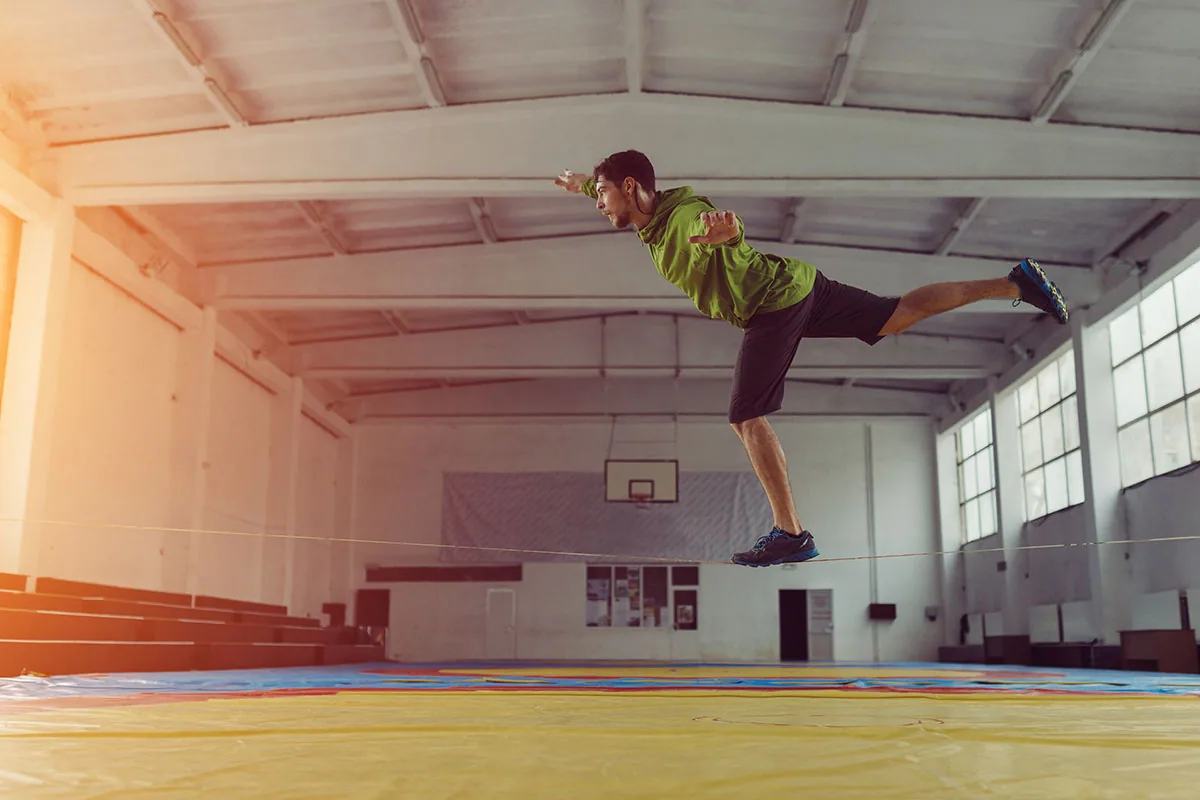
Breathe. Spread your arms. Put one foot in front of the other, and keep going for at least 50 meters.
Many people might consider these movements simple, but for many others, doing them amounts to playing a sport. In that case, you could easily take sides and say that a simple walk of a few meters can’t be a sport. And indeed, it is something different. It is an art. Especially when those simple movements are performed while balancing on a strap just a few centimeters wide, suspended in midair.
Slacklining: balancing on your own senses
It was the 1980s when two guys in California were having fun walking in balance on a rope suspended in the air. They would probably never have imagined that years later that rope would be replaced by a strap, and their game would become a discipline practiced all over the world. But what exactly are we talking about?
Slacklining, which literally means “loose line”, doesn’t fit neatly into classic terms such as “sport”, “art” or “discipline”, or perhaps it is all of them. Basically, what you do is walk on a strap, generally between 2.5 and 5 centimeters wide. It is anchored at two points of different heights, depending on the specialty practiced, from 50 cm off the ground all the way to the top of a mountain, with nothing but empty space beneath you.
Depending on your skills and how daring you are, you can decide whether to perform jumps landing in balance on the strap each time, take walks hundreds of meters long, or follow a shorter route but while balancing at dizzying heights, such as at the top of a mountain.
So? Tightrope walking! Not quite: in slacklining you are not allowed to use poles or any other tool that could give you more balance. There is a trick, but it lies elsewhere.
The secret of slacklining
Our body is covered in receptors that let us perceive the outside world. Some make us feel hot or cold, others make us feel pain, and still others help us understand how our body is positioned in space.
Of all the areas of the body, our foot is the richest in a particular type of receptor called “proprioceptors”, whose purpose is to provide feedback (information in return) on the movements the body makes moment by moment.
The foot has the highest density of proprioceptors: we have them on the heel, on the heads of the metatarsals, on the big toe, and so on. This huge amount of information, gathered and processed in near-zero time, is used to create mechanisms for managing and controlling the various body segments, with the aim of keeping the center of gravity stable and preventing us from losing our balance.
So there are no tricks, no gimmicks, and no specific equipment is needed to practice this discipline; what you need is simple, total control of your own body.
Find your balance!
While in many sports, beyond technique, a certain physique is very often considered essential, in slacklining what matters is not the shape or size of our body but how well we can manage it.
It is therefore essential to have, or to learn, great mastery of the basic movements; you definitely need good joint mobility but also great stability, especially in the ankles and the core. These abilities can be learned simply by practicing slacklining regularly, but they are also typical of people who practice various types of sport, even very different from one another, such as climbing, dance and martial arts. There is, however, a component that is very often left out when we talk about sport and that here is just as important as acquiring the right technique: controlling your emotions and being able to focus on what you are doing at that exact moment.
While it is true that our feet are rich in sensors that report every tiny shift happening at their level, it is also true that we must be focused enough to react quickly and precisely to every bit of micro-information we receive, moment after moment.
How can you best prepare for this extraordinary discipline?
1. Prepare your body from the outside.
As with any physical activity, slacklining also requires a minimum of preparation. This is aimed mostly at everything involving the feet, ankles and core. It is a good idea to train the flexibility, mobility and endurance of the ankle muscles and joint. This is one of the few cases where tools like balance discs and proprioceptive boards can be truly useful.
2. Prepare your body from the inside.
As with any sport, nutrition plays a fundamental role. When you are walking on a few centimeters of strap, suspended even tens of meters above the ground, or performing tricks of all kinds, you cannot risk not having the right support from the nutrients you get through your diet. This is a highly specific topic that Eathlon® will be able to break down to the smallest detail, finding personalized solutions for each person and specific need.
3. Prepare your mind.
Concentration in slacklining is just as important as physical fitness. People who practice disciplines such as yoga and meditation will certainly have an advantage. Everyone else will have to slowly learn to connect their body and mind more and more.
It is often said, even with some exaggeration, that the life or fate of many people hangs by a thread. If that were literally true, a slackliner wouldn’t be afraid of that statement but would use that thread to train!
—–
Author
FABRIZIO MONTICONE
Federal lecturer and FIPE – CONI certifier, he specializes in exercise biomechanics and trains instructors and personal trainers. He works as a Master Trainer for major international companies including Technogym.