The Plank and Its Variations to Strengthen Your Core
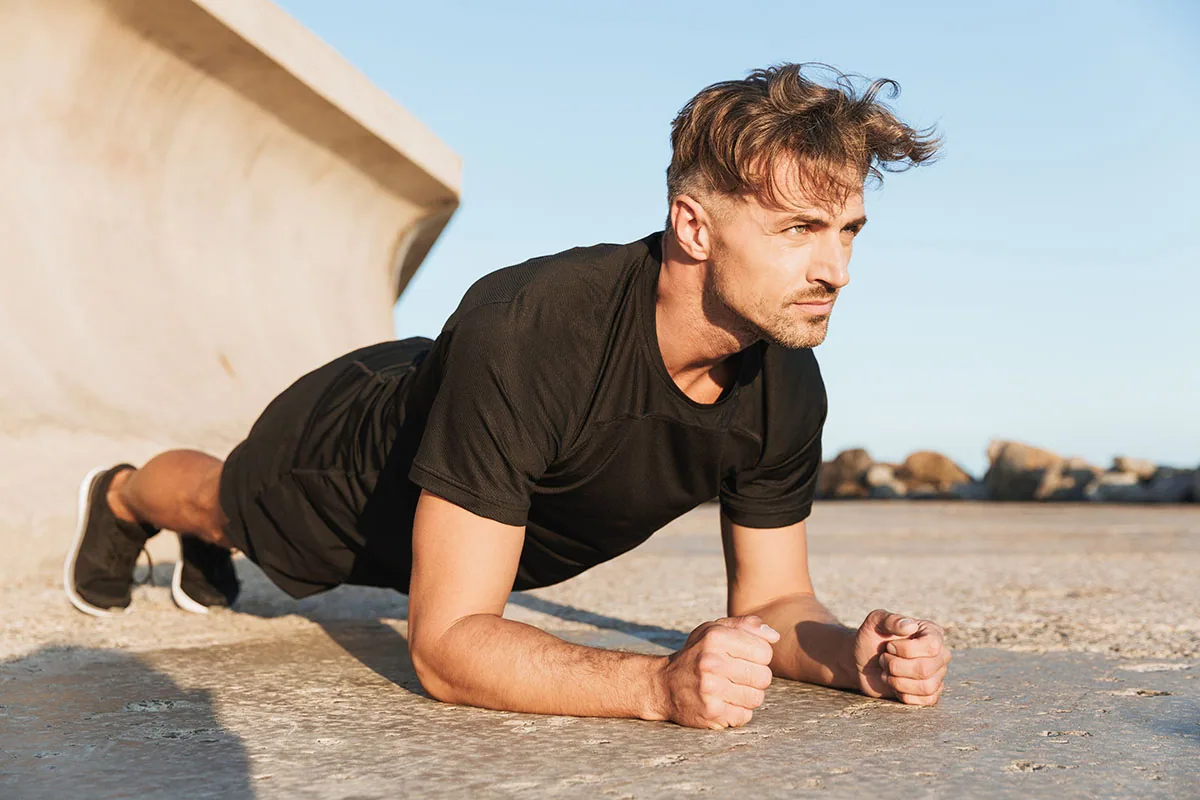
Often snubbed or overlooked in favor of lengthening-and-shortening exercises like crunches, the plank is actually one of the best ways to work the area that provides stability and balance to our whole body, namely the core.
WHICH MUSCLES DOES THE PLANK ACTIVATE?
The plank is a decidedly complete exercise that requires the activation of a series of the most important muscles in our body.
Let’s start with the best-known ones, the ones people usually train to muscle failure:
- The rectus abdominis: for non-experts, the so-called “six-pack”
- The internal and external obliques, important both for aesthetics and for the core
- The transversus abdominis, a key muscle for trunk stability
- The gluteal muscles (especially the gluteus maximus and medius), essential for supporting the back and pelvis and for giving you a nice backside
- The diaphragm, which activates to maintain core stability
- The back muscles (quadratus lumborum, multifidus and paraspinals), significant for obvious reasons
- The pelvic floor muscles, extremely important in rehabilitation and for core stability, but often forgotten
- The shoulder muscles (such as the anterior deltoid) and the neck muscles, which are partly engaged
We mentioned the crunch earlier, a non-isometric exercise for training the abs.
Let’s look at the differences between the plank and the crunch and which of the two exercises can give us more benefit.
The biodynamic analysis of the abdominal muscles tells us that their main function in human physiology is static, not dynamic.
In fact, the main function of the abdominal muscles is not to move the trunk, but to stabilize it and protect the back when the back is under tension.
It is easy to see why the plank is a better exercise than the crunch (which you can still do, of course) thanks to the variety of muscles involved and, above all, its static postural biomechanics.
Today we will look at how to perform three variations of the abdominal plank, namely the side plank and the alternating-leg plank.
Download the Eathlon® app, the first 7 days are a free trial
PLANK:
- Keep your elbows directly under your shoulders (arms not too far apart or too close together)
- Keep your head and neck straight
- Keep your legs straight without bending your knees
- Squeeze your glutes to keep your hips balanced
- Avoid tilting your hips to the side or keeping your glutes too high
- Keep your abs contracted to support your spine
- Don’t let your pelvis drop toward the floor by arching your back
- Don’t round your shoulders; try to keep your shoulder blades down and open your chest
SIDE PLANK:
- Get on the floor on one side with your elbow and forearm resting on the ground, forming a 90-degree angle
- The elbow must be under the corresponding shoulder
- Legs extended and feet together, or with the foot opposite the elbow placed in front of the other
- Head, shoulders, spine and pelvis in complete alignment
- Lift your pelvis, starting the movement from the elbow and feet, and work to prevent your trunk and pelvis from tilting by contracting your glutes, oblique abs and quadratus lumborum
ALTERNATING-LEG PLANK:
- Plank position with straight legs and elbows under your shoulders
- Lift your legs alternately, creating instability
As always, let’s remember how important it is to pair physical activity with a healthy, balanced diet.
In this regard, Eathlon® favors the use of extra virgin olive oil, which is a natural medicine and a metabolic activator through sirtuins.
Not only that, it is a food that contributes to body growth and bone formation.
And now, let’s get planking!