Examples of Functional Snacks Before and After a “Cardio” Workout

What should you eat before a workout? And after?
There are many variables to consider if you want to answer these two questions properly.
People often say not to eat for two hours before exercising, on the assumption that our body shouldn’t be busy digesting during a workout. In my experience, though, one of the biggest mistakes made by newcomers to gyms and sports centers is showing up on an empty stomach.
A breakfast of cappuccino and a pastry, plus a quick sandwich at lunch, is not enough to avoid a near-certain drop in blood sugar after 30 minutes of exercise at 6 p.m., the classic time when gyms all over the world fill up.
The result? Dizziness, nausea and pale faces looking for sugar.
Starting a workout hungry means running out of energy early, breaking down muscle tissue, and training halfheartedly with nothing to show for it.
On the other hand, it would be extremely counterproductive to overindulge before training.
A way of eating that keeps your blood sugar steady for most of the day lays the right foundation for good athletic performance. Let’s make this saying our own: “steady blood sugar, quiet appetite”.
Small, frequent meals rather than rare but large ones avoid the lipotropic effect and keep the digestive system from being overloaded.
Blood sugar swings, on the other hand, affect both physical and mental activity, resulting in lower performance.
Now that we have established how essential it is to provide the right nourishment throughout the day, let’s try to understand better what an athlete should eat before and after a “cardio” workout.
Cardio is short for aerobic cardiovascular training, that is, a prolonged workout that stays within the limit of your aerobic capacity.
In other words, a workout that stimulates the cardiovascular system with a training heart rate between 65% and 85% of your maximum heart rate, drawing on a mix of glycogen and fatty acids as its energy source.
The aim of this type of training is therefore to improve cardiovascular and lung function, lower blood pressure, and increase calorie expenditure and fat oxidation.
This clarification is necessary because, depending on the person’s goal, diet has to be adjusted in step with training.
Moreover, the same snacks carry different weight depending on whether the workout is done in the morning, in the afternoon or in the evening.
Pre-workout snack
We are talking about a mini-meal to be eaten from one hour to a few minutes before training or competition; the goal is to have the fuel you need to get through the workout with the right energy.
The pre-workout meal must be highly digestible and energy-dense (approx. 250-300 kcal).
It should be mostly carbohydrate, ideally from foods with a low to medium glycemic index, depending on the length of the workout.
Also, ahead of an athletic performance (as opposed to a workout aimed at aesthetics), we can also consider a liquid snack during training, such as maltodextrins.
Before an athletic performance, getting the pre-competition snack wrong can compromise the result, causing digestive trouble, acidity, reflux or intestinal problems.
A high-protein meal could cause muscle cramps, since protein metabolism draws water into the digestive system, taking it away from the muscles under tension.
The goal is to ensure gastric emptying and intestinal absorption.
Athletes who feel the emotional strain of performing can opt for liquid foods (for example smoothies).
Avoid foods with a lot of fiber or fat, and foods or drinks full of refined sugars.
The following chart can help you understand at a glance the timing of macronutrient intake as the workout approaches. 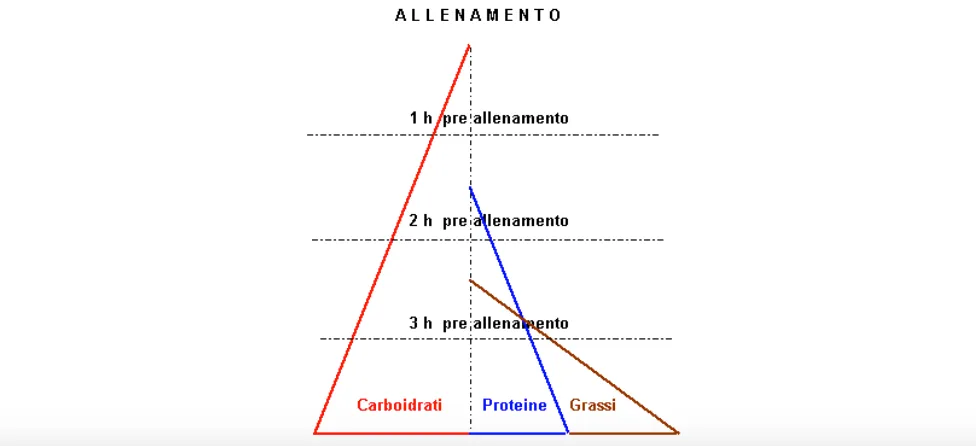
Just as an example:
1 hour before the workout:
- Cereal flakes with milk
- Cow’s milk or soy yogurt with fresh fruit pieces
- Sports bar (higher in carbs and lower in protein)
- If you have no weight issues, sultana raisins together with Greek yogurt can also be a tasty solution
20-30 minutes before:
- Fresh fruit, such as a banana
Download the Eathlon app, the first 7 days are a free trial
And after the workout?
They say that “the muscle first recovers and then thinks about growing”; this is to make the best use of the so-called “anabolic window”, the short period after training when the muscle, like a sponge, is primed to absorb energy and nutrients in order to repair muscle tissue and restore energy stores (glycogen).
It is essential to balance this meal well, depending on the sport you practice, its duration and the intensity of the effort, so as not to cause performance drops in the following days.
In general, though, it is recommended to take medium- and high-glycemic-index carbohydrates to restore the glycogen stores used up during exercise within 30 minutes after the workout (waiting longer could undermine recovery by slowing the rebuilding of stores) along with “fast proteins”, such as hydrolyzed whey protein, to repair and promote the rebuilding of muscle tissue through supercompensation.
A few examples:
For a recreational athlete, for the reasons above, a piece of fruit or a fresh-squeezed juice might be enough if the workout takes place in the early evening and dinner is coming up shortly after. Otherwise, if the workout takes place in the early afternoon, a small plain or whole-wheat roll with bresaola or roast turkey, a drizzle of extra virgin olive oil and tomato/salad will certainly satisfy most average users.
In any case, dinner will then include all 3 macronutrients, with a different calorie intake clearly depending on the person and their needs.
Last but not least, depending on the effort, you will certainly need to replenish fluids and, after a prolonged workout, minerals (read our article on Minerals and supplementation in summer: tips for every sport).
I want to stress that this advice should then be turned into a diet that is as personalized as possible.
By following the Eathlon® platform, you can stay up to date on how nutrition and training have a positive effect on your health, well-being and performance.
———
Author
DR. PIERLUIGI VAGALI
Nutritionist (biologist), lecturer at the University of Genoa and the Alma Graduate School in Bologna, and a speaker at conferences across Europe on “Physical activity, well-being and Healthy Aging”. Athletic trainer, manager and scientific advisor for the best-known fitness chains.