Vitamin Supplements in Winter
In winter, at the first sign of a cold, we remember how important they are.
Even more so now, in the middle of a pandemic, when we keep hearing about the immune system and low natural defenses.
What are vitamins?
Vitamins are a group of organic substances, known as micronutrients, that, even in small amounts, are able to influence the processes taking place in our body, and are essential for cellular metabolism.
Their regulatory role is carried out by substances that control the speed of the biochemical reactions involved in metabolic processes.
They cannot be synthesized by the human body, so they have to be taken in through food (with the exception of Vitamin D, 80% of which is synthesized through exposure to sunlight).
Although they provide no energy, vitamins act as biocatalysts (coenzymes) in the metabolism of nutrients and in energy processes.
They are also called “protective foods” because without them it is impossible to build protoplasm (the set of substances contained in the cell) and release energy.
Vitamins are not always taken in as such, because they can come from compounds called provitamins that the body converts into the active form.
Essential for growth and for maintaining vital functions, these compounds must be taken regularly to avoid deficiency syndromes, including avitaminosis, the total lack of one or more vitamins, a condition that is now extremely rare, or hypovitaminosis, the partial lack of one or more vitamins, a less serious but more widespread condition whose main causes are an inadequate or overly restrictive diet, altered intestinal absorption (malabsorption), chronic alcoholism, and interference from certain drugs (for example some antibiotics, estrogen-progestin pills, anticoagulants, etc.)
By contrast, hypervitaminosis is a toxic state caused by excessive doses of vitamins from unbalanced diets and pharmaceutical supplements. It is more likely to occur with fat-soluble vitamins, which can build up in the liver.
The vitamin requirement depends on the age, physiological condition, eating habits and physical activity of the person taking them.
Vitamins fall into two groups:
- Fat-soluble vitamins, which dissolve in fats, include: A, D, E, K
- Water-soluble vitamins, which dissolve in water: B GROUP: B1, B2, B6, B12, NIACIN (B3), PANTOTHENIC ACID (B5), BIOTIN (H-B8), FOLIC ACID (B9), C.
Fat-soluble vitamins can gradually accumulate in fatty tissue; water-soluble ones have a tissue saturation level, beyond which they are eliminated in the urine.
Vitamin D
In winter, when most of our time is spent indoors at home, at school or in an office, a deficiency of this vitamin is very likely. Statistically, in Italy today one in two Italians is deficient in vitamin D. This deficiency has also made the headlines because of the spread of the coronavirus, so it deserves a closer look.
In nature it exists in several forms. The most important for humans is D3, or cholecalciferol, which derives from cholesterol and is synthesized by animal organisms; D2, or ergocalciferol, which derives from ergosterol found in plants, is also essential. Vitamin D is synthesized in the skin thanks to a specific wavelength of sunlight (290/310 nm). Cholecalciferol is activated through two hydroxylation reactions, one in the liver and the second in the kidney.
Vitamin D is stored in the liver mainly as 25-hydroxycholecalciferol and acts on calcium and phosphorus metabolism by helping the body absorb and use calcium. This is why vitamin D deficiency, also called the antirachitic vitamin deficiency, causes rickets in children, a condition characterized by altered calcification of the long bones; in adults, a deficiency can lead to osteomalacia, characterized by severe bone deformities.
The role of vitamin D in calcium homeostasis means it regulates the metabolic system in three ways: by increasing the absorption of calcium (and inorganic phosphate from the intestine), by increasing the reabsorption of calcium by the kidney and, finally, by increasing bone resorption (when needed) so that calcium is released into the bloodstream, thus raising the plasma concentration of calcium ions.
Vitamin D acts as an immunomodulator, essential for the proper functioning of our immune system.
The inactive form of vitamin D that we take through supplements (cholecalciferol) has a half-life of 1 day; this means that if we take 10,000 IU, the next day we have 5,000 IU available, after 3 days 2,500, after 4 days 1,250, and so on until it is completely used up (see the chart below).
Taking a high monthly or quarterly dose immediately raises the level in the blood, but does not make it available on a daily basis in the tissues, where it is needed most. After a few days, vitamin D drops to zero. Studies show that, once a deficiency has been confirmed by a blood test, it should be supplemented every day and not in weekly or monthly super-doses. 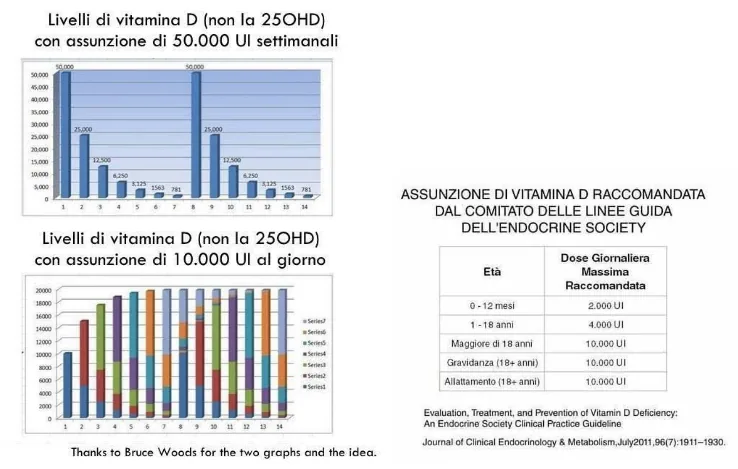
Vitamin K
(Menaquinone): Together with vitamin D, a supplement of Vitamin K (K2) is recommended in order to “fix” calcium in the bone structure and prevent it from being deposited in the bloodstream. K2 in fact activates special proteins that mobilize calcium, stimulates osteocalcin, which draws calcium toward bone tissue, and promotes MGP (Matrix GLA Protein), which mobilizes calcium from the arteries and prevents it from building up there.
Leafy green vegetables are good sources of vitamin K, such as spinach, lettuce, broccoli and cabbage (K1). It is an antihemorrhagic, promotes blood clotting and improves oxygen transport by red blood cells. A deficiency causes hemorrhages.
Take 100-200 mcg together with Vitamin D.
Vitamin A
(Retinol, of animal origin, and beta-carotene, of plant origin). It is essential for maintaining the anatomical and functional integrity of the epithelia, mucous membranes and immune system, for normal body growth and reproduction, and for vision in low light.
It is found in liver, (whole) milk and dairy products, and eggs, and in plant foods in the form of carotenes in yellow/orange and green fruit and vegetables: carrots, spinach, bell peppers, tomatoes, apricots, persimmons, mango, melon, etc. A vitamin A deficiency is often associated with general malnutrition, malabsorption or chronic alcoholism.
Vitamin E
(Tocopherol): A powerful antioxidant that fights free radicals. It is found in all seeds, some grains, fruit and vegetable oils. Vitamin E deficiency is not seen in healthy individuals, since most diets contain adequate amounts.
B Group
This group of vitamins has many functions. A supplement of the complex as a whole is usually suggested after antibiotics, or in cases of tiredness, stress and fatigue. Depending on sex, age, eating and sports habits or particular conditions (e.g. pregnancy), more specific supplementation may be needed.
Vitamin B1 (thiamine): Involved in carbohydrate metabolism.
It is found in pork and whole grains. Its deficiency is associated with beriberi, known for centuries in its wet form (heart failure) or dry form (polyneuritis). Together with a deficiency of other vitamins (PP, B6, B12), it is currently held responsible for peripheral nerve damage (polyneuritis) in chronic alcoholism. Acute deficiencies, often linked to alcohol abuse (intestinal absorption is greatly reduced) or drug abuse, cause lesions of the central nervous system (Wernicke’s encephalopathy).
Vitamin B2 (riboflavin): Involved in oxidation-reduction reactions. It is found in milk and dairy products, eggs and liver, whole grains and leafy green vegetables.
Vitamin B2 deficiency shows up through a series of symptoms affecting the mouth (angular stomatitis, geographic tongue), the eye (corneal vascularization), and the skin of the face and genitals (erythema).
Vitamin PP (B3 – niacin): Vitamin PP is a component of two coenzymes (NAD and NADP) responsible for transporting hydrogen ions (H+) and forming compounds containing energy-rich bonds (ATP). It is present in both animal and plant foods.
The classic deficiency disease is pellagra, with a clinical picture characterized by skin lesions (dermatitis) on the parts exposed to sunlight, digestive symptoms (loss of appetite, diarrhea, stomatitis) and neuropsychiatric disorders (polyneuritis, psychosis, dementia): the 3 Ds (DIARRHEA, DERMATITIS, DEMENTIA).
Vitamin B5 (pantothenic acid): plays a fundamental role in lipid metabolism, taking part in the synthesis of cholesterol. It prevents aging of the skin and tissues. It is found in yeast, egg yolk and vegetables. It carries other vitamins.
Vitamin B6 (pyridoxine): Involved in protein metabolism.
It is present in animal and plant foods. In humans, pyridoxine deficiency is very rare. It is involved in the metabolism of carbohydrates, proteins and fats as a coenzyme.
Vitamin B7 (Inositol): Stimulates the production of lecithin, which “cleans” the walls of the arteries and helps reduce cholesterol in the blood.
It helps maintain memory by counteracting the deterioration of nerve cells. It is found in brewer’s yeast and whole grains, citrus fruit, egg yolk, walnuts and bananas. Also in meat in general and especially in liver.
Vitamin B8 (Vitamin H-Biotin): involved in protein metabolism and in the synthesis of fatty acids and glucose.
It is found in milk and cheese, egg yolk, liver, peanuts, vegetables, mushrooms and brewer’s yeast. Supplementation with this vitamin is used as an aid for hair loss. Professional athletes need about twice as much as the average person because of their high energy expenditure and rapid protein synthesis.
Vitamin B9 (folic acid): Takes part in the formation of DNA and RNA, in the methylation of homocysteine to methionine and in the metabolism of some amino acids.
It is found in leafy vegetables, liver, eggs and beans. Folic acid deficiency typically shows up as macrocytic anemia. In pregnancy it is a risk factor for spina bifida in the unborn child, so supplementation is generally recommended during that period. It is also measured in cases of alcoholism.
Vitamin B12 (cobalamin): Together with folates, it takes part in the formation of DNA and RNA. It is found only in foods of animal origin (liver, meat). Its deficiency is associated with macrocytic anemia and demyelination of the nerve fibers running through the spinal cord.
With a normal diet, deficiency is rare except in certain distal ileum absorption problems. Supplementation may be recommended on a vegetarian diet.
Vitamin C
(ascorbic acid): of all the vitamins, perhaps the best known, even more so during lockdown. A super antioxidant, it strengthens the immune system. It is involved in the formation of collagen and adrenaline. It regulates the resistance and permeability of capillaries. It promotes intestinal absorption of iron.
It is found in citrus fruit, bell peppers, tomatoes, kiwi and fresh leafy green vegetables. In adults the classic deficiency disease is scurvy, characterized by hemorrhages and capillary fragility, while in children it also comes with bone growth disorders.
Supplementation is suggested during the winter months, actively working against illnesses caused by chills, at 1 to 2 g, preferably slow-release.
To conclude, every micronutrient works synergistically with the others, and “do-it-yourself” supplementation without clinical checks can lead to side effects that you could never predict from reading a package leaflet.
By following the Eathlon platform, you can stay up to date on how nutrition and training have a positive effect on your health, well-being and performance.
———
Author
DR. PIERLUIGI VAGALI
Nutritionist (biologist), lecturer at the University of Genoa and the Alma Graduate School in Bologna, and a speaker at conferences across Europe on “Physical activity, well-being and Healthy Aging”. Athletic trainer, manager and scientific advisor for the best-known fitness chains.